
WELCOME BONUS 300%
UP TO €2000 + 100
FREE SPINS
UP TO €2000 + 100
FREE SPINS
Home → Blackjack
Blackjack at Valtti Casino: Variants, Rules and Payouts
Early Surrender Is Gone From Many Tables
Late surrender in Blackjack Surrender lets the player give up the hand after the dealer has checked for blackjack and lose half the stake, so a €100 bet returns €50 and the house edge drops by 0.08 percentage points. Early surrender is worth far more, up to 0.6 percentage points, but it is extremely rare. That gap of roughly 0.52 percentage points is why tables that strip early surrender hand the player a weaker game.
The 6-deck, S17, DAS, DOA table with a 3:2 payout pays a natural blackjack 3:2, so a €10 stake returns €15, and it carries an RTP of 99.54%. The Liberal Vegas Strip rule set reaches 99.72%, a house edge of 0.28%, by adding S17, DAS, resplit and late surrender together. A player staking €100 per round therefore keeps €99.54 on the first table and €99.72 on the second.
Single deck, classic rules with a 3:2 payout returns 99.85% and a house edge of just 0.15%, about 0.48 percentage points better than 8 decks. That advantage disappears when the same table pays 6:5 instead of 3:2: a €10 blackjack pays €12 rather than €15, and the house edge jumps to 1.85%. Late surrender alone recovers only 0.08 of those points.
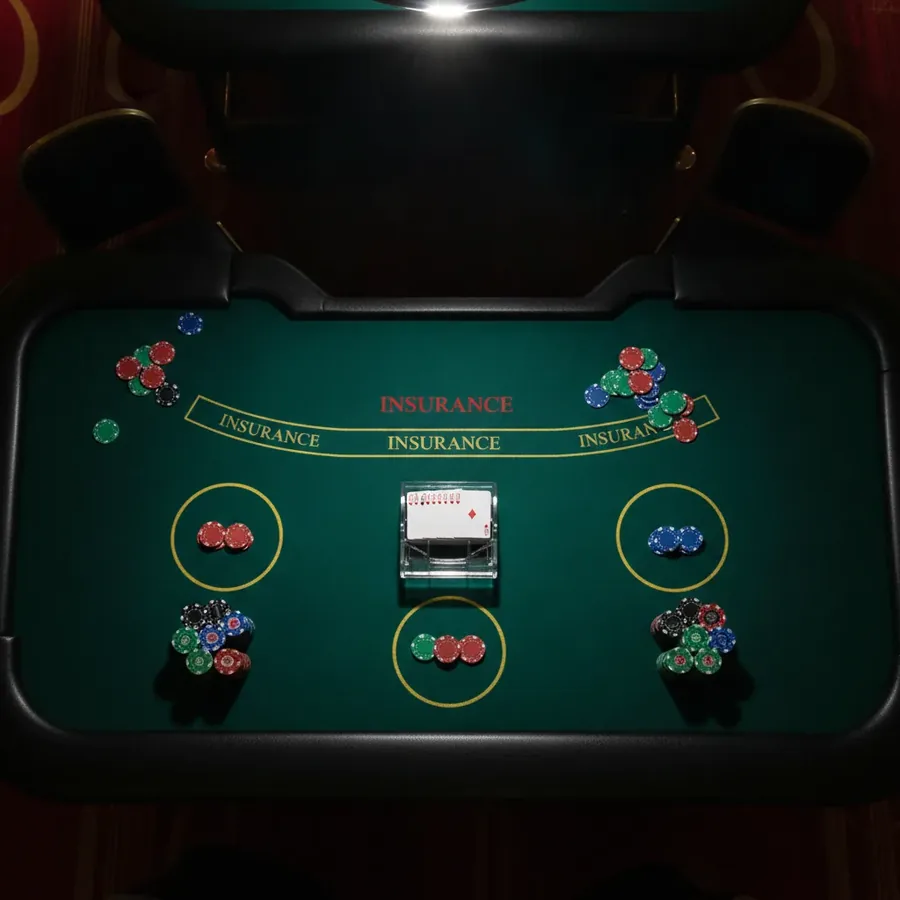
Side Bets Raise the House Edge to 5%
Insurance on a 6- to 8-deck shoe carries a house edge of 7.47% and an RTP of 92.53%, and it pays 2:1 when the dealer turns over a blackjack. Basic strategy always declines it, since the bet is worth less than the main hand. A single-deck version cuts the edge to about 5.88%, still far above the 0.46% of the standard 6-deck game.
Doubling a €50 insurance bet on a €100 main hand is legal up to 50% of the main bet, and the €50 loses outright whenever the dealer does not have blackjack. Insurance pays 2:1, so €50 returns €150 on a win, but the 7.47% edge means €100 of insurance stakes costs €7.47 on average. Only card counters at a true count of +3 or higher have a reason to take it.
The Infinite Blackjack side bets from Evolution, Any Pair, 21+3, Hot 3 and Bust It, sit on a table with a 99.47% RTP on the main game. Lightning Blackjack pays 99.56% on the base hand, while the 6:5 payout table drops to 98.15%, a house edge of 1.85%. A €100 stake on the 6:5 table therefore costs €1.85 per round before any side bet is added.
Surrender or Play On With 16 Against a 10
Late surrender on Blackjack Surrender improves the return by about 0.08 percentage points and returns 50% of the stake, so a €100 hand is closed for €50. Early surrender is worth up to 0.6 percentage points but is extremely rare at live tables. The difference between the two rules is roughly 0.52 percentage points on the same hand.
The Liberal Vegas Strip rule set combines S17, DAS, resplit and late surrender for an RTP of 99.72% and a house edge of 0.28%, with a standard deviation of 1.15. The 6-deck, S17, DAS, DOA table without surrender returns 99.54%, a house edge of 0.46%. Surrender alone is therefore worth about 0.18 percentage points between those two rule sets.
Resplitting aces adds 0.08 percentage points and doubling after a split adds about 0.14 percentage points, while 6 decks instead of 8 adds roughly 0.02 percentage points. Dealer hits soft 17 takes 0.22 percentage points away from the player. On a €100 stake the H17 rule alone costs €0.22 per round, more than double what late surrender gives back.
Blackjack variants at a glance
| Variant | Payout | House edge | Rule | RTP |
|---|---|---|---|---|
| Blackjack Single deck, classic rules, 3:2 | Blackjack 3:2, win 1:1 | 0.15% | Fewer decks = lower edge; one deck gives about −0.48 percentage points compared with 8 decks. Often offset by a 6:5 payout. | 99.85% |
| Blackjack 6:5 payout instead of 3:2 (6 decks) | Blackjack 6:5, win 1:1 | 1.85% | Replacing 3:2 with 6:5 adds exactly +1.39 percentage points to the casino's edge – more than any other rule change. On a €10 bet a blackjack pays €12 instead of €15. | 98.15% |
| Blackjack Surrender (late surrender) – rule effect | 50% of the stake returned | −0.08 percentage points | The player gives up the hand after the dealer has checked for blackjack and loses half the stake. Improves RTP by about 0.08 percentage points. Early surrender is worth much more (up to −0.6 percentage points) but is extremely rare. | n/a (rule modifier) |
| Blackjack Liberal Vegas Strip (liberal rules, 3:2) | Blackjack 3:2, win 1:1 | 0.28% | The most player-friendly rule set: S17 + DAS + resplit + late surrender. Standard deviation 1.15 | 99.72% |
| Blackjack 6 decks, S17, DAS, DOA, 3:2 payout, basic strategy | Blackjack 3:2, regular win 1:1, insurance 2:1 | 0.46% | Dealer stands on soft 17; double down on any first two cards; doubling after a split allowed; no surrender. Basic strategy is required to reach this figure | 99.54% |
| Blackjack Split / double / H17 – rule effects | Double – stake ×2 with one card; split – up to 4 hands; split aces usually get one card each. | H17 +0.22 percentage points; RSA −0.08 percentage points; DAS −0.14 percentage points | Dealer hitting soft 17 lowers RTP by 0.22 percentage points; resplitting aces improves it by 0.08 percentage points; doubling after a split improves it by about 0.14 percentage points; 6 decks instead of 8 – about 0.02 percentage points. | n/a (rule modifiers) |
What the Hole Card Means at a Live Table
The hole card is the dealer's facedown card at a live blackjack table, visible only after all player hands are complete. At a table with dealer stands on soft 17, this card determines whether the dealer has a made hand or must draw. The player never sees the hole card before acting, so decisions are made against an incomplete hand.
Evolution operates Blackjack Party, Lightning Blackjack and Infinite Blackjack with bet ranges from 1.00 EUR to 5,000 EUR. On these live tables the dealer checks for blackjack when the upcard is an ace or a ten, but the hole card stays concealed. An insurance side bet of up to 50% of the main bet is offered only when the upcard is an ace and pays 2:1.
The hole card matters most when the upcard is a ten, because a dealer blackjack ends the round before players can act on a 16. With six decks and S17, the house edge is 0.46% assuming basic strategy. A player holding 16 against a 10 faces an average loss of 46 cents per 100 EUR staked when the dealer has already checked the hole card.
No Doubling Down on Three Cards
Double down is allowed only on the first two cards in standard blackjack variants, including the six-deck S17 game with an RTP of 99.54%. A third card removes the option to double, because the house edge calculation assumes the player can stake twice only once per hand. The rule is fixed and not modified by side bets.
The six-deck table lists double down on any first two cards, doubling after a split allowed, and no surrender. A player who receives a third card must choose between hit and stand only. This restricts the doubling option to exactly the initial two-card total, which is a core condition for reaching the 0.46% house edge.
At Lightning Blackjack, Infinite Blackjack and Blackjack Party from Evolution, the same standard applies. A hand of 9 against a dealer 6 is a basic strategy double, but only before a third card is drawn. Missing that window turns a profitable double into a single stake, and the long-run cost is the difference between doubling at an edge and playing the total as a hit or stand decision.
When Can You Raise Your Bet?
A player can increase the stake only before the cards are dealt, because double down is the sole legal way to add money mid-hand. Double down on any first two cards is listed for the six-deck S17 game, and the player adds exactly one additional stake, receiving one more card. This is bet increase as a rule, not as a betting system.
Doubling after a split is permitted in the six-deck game and improves RTP by about 0.14 percentage points. A player who splits a pair of 8s against a 6 can double the resulting hands if the next card produces a favourable total. The single-deck classic rules variant has an RTP of 99.85%, the highest among the listed blackjack games, with a house edge of 0.15%.
The welcome offer is a 300% bonus up to 2,000 EUR plus 100 free spins. That is the only listed mechanism for increasing the bankroll outside the table rules. A 50 EUR deposit becomes 150 EUR of bonus money, so the balance is 200 EUR before any wagering. The offer appears once and is not a live-table betting increase.
Stop the Session After a 30 Percent Loss
A session stop at a 30% loss is a money-management tool, not a game rule. The six-deck blackjack game keeps a house edge of 0.46%, which means every 100 EUR of stakes costs 0.46 EUR on average over the long run. A 30% loss on a 500 EUR session bankroll is 150 EUR, reached after many hands of negative variance.
The house edge on Blackjack Liberal Vegas Strip is 0.28%, and the single-deck classic rules game is 0.15%. A 30% stop-loss prevents a single session from erasing a bankroll, because the theoretical edge alone rarely causes a 30% drop in one sitting. The stop is applied to the session bankroll, not to the welcome bonus of 2,000 EUR.
The 6:5 payout variant has a house edge of 1.85%, which is 1.39 percentage points higher than the 3:2 payout. A player betting 10 EUR receives 12 EUR for a blackjack under 6:5 instead of 15 EUR under 3:2. A 30% loss stop triggers more quickly at a 6:5 table, because the higher house edge reduces the average return per blackjack.
The 3:2 Blackjack Payout Explained
A blackjack payout of 3:2 returns 150 EUR on a 100 EUR stake, while the 6:5 alternative pays only 120 EUR for the same hand. The gap of 30 EUR per blackjack is not cosmetic: replacing 3:2 with 6:5 adds exactly 1.39 percentage points to the casino's edge, more than any other single rule change in the game.
That shift moves the return from the 99.54% available on a six-deck game with S17, DAS and DOA to 98.15% on the six-deck 6:5 version. On a 10 EUR bet the blackjack pays 12 EUR instead of 15 EUR, so the shortfall compounds across every natural the player draws over a session.
For comparison, a single-deck game with classic rules and a 3:2 payout reaches 99.85% RTP, the highest figure among the listed rule sets, while the Liberal Vegas Strip configuration with S17, DAS, resplit and late surrender sits at 99.72%. Both keep the full 3:2 payout, so the 6:5 rule costs more than most players assume.
The Insurance Mistake: 7% Extra House Edge
Blackjack Insurance on six to eight decks carries an RTP of 92.53% and a house edge of 7.47%, far above the 0.46% edge of a six-deck game with S17, DAS, DOA and a 3:2 payout. The side bet pays 2:1 and may be placed for up to 50% of the main bet when the dealer shows an ace.
Basic strategy always declines insurance, with the only exception being card counters at a true count of +3 or higher. On a single deck the edge falls to roughly 5.88%, still several times the main-game edge, so the side bet remains a costly addition for the ordinary player.
The contrast with the Liberal Vegas Strip rule set is stark: that configuration runs at 99.72% RTP and a 0.28% house edge. Taking insurance on a 100 EUR main bet with the maximum 50 EUR side stake exposes an extra 50 EUR to a 7.47% edge, a cost the main wager never carries.
Soft vs Hard Hands in Practice
A soft hand contains an ace counted as 11, and the dealer's decision on soft 17 is worth 0.22 percentage points of house edge: hitting it lowers RTP, standing on it raises it. The Liberal Vegas Strip rule set uses S17 and reaches 99.72% RTP with a 0.28% house edge, while the 6:5 six-deck game runs at 98.15% RTP with a 1.85% edge.
Doubling after a split improves the return by about 0.14 percentage points, and resplitting aces adds roughly 0.08 percentage points. A hard hand has no ace valued at 11, so the same total of 16 cannot be softened by a later card, which changes the correct basic strategy decision.
Doubling doubles the stake with one card, a split creates up to four hands, and split aces usually receive one card each. Six decks instead of eight adds about 0.02 percentage points, a small gain next to the 1.39 percentage points lost by moving from 3:2 to 6:5.
Calling Late Surrender Correctly in Three Steps
Late surrender lets the player give up the hand after the dealer has checked for blackjack and lose half the stake, improving RTP by about 0.08 percentage points. The Liberal Vegas Strip rule set includes late surrender alongside S17, DAS and resplit, and reaches 99.72% RTP with a 0.28% house edge.
The three steps are: wait until the dealer has checked the hole card for blackjack, then declare the surrender before any further action, then accept the return of 50% of the stake. On a 100 EUR wager the player receives 50 EUR back, so the loss is capped at half the bet rather than the full amount.
Early surrender is worth up to 0.6 percentage points but is extremely rare, and the six-deck S17 game with DAS, DOA and a 3:2 payout does not offer surrender at all, holding at 99.54% RTP and a 0.46% house edge. On a 200 EUR stake, late surrender returns 100 EUR.
Continuous Shuffling Machines Reshuffle After Every Round
A continuous shuffling machine returns cards to the shoe after every round, so the deck composition is constantly reshuffled instead of being dealt down to a cut card. That differs from the fixed six-deck and eight-deck shoes behind the 99.54% RTP version with S17, DAS and DOA, and behind the 6:5 game at 98.15% RTP with a 1.85% edge.
Card counting depends on tracking the ratio of high to low cards, and insurance is only worth taking at a true count of +3 or higher. When the shoe is reshuffled after each round, that ratio resets constantly, so the counter's edge disappears while the 7.47% house edge on insurance remains.
The single-deck classic game at 99.85% RTP and a 0.15% house edge relies on a limited deck, and fewer decks lower the edge by about 0.48 percentage points against eight decks. A machine that shuffles after each round removes that deck-depth effect entirely, so the player faces a flat, unchanging composition.
Contact
Live - online chat
Banking









Providers












Valtti Casino 2026